A.X.I.S.
COMPUTATION
PLUGIN DEVELOPMENT
Conducted during a summer internship at Populous
Tech stack: Rhino, Grasshopper, Python, Eto, After Effects, Premiere Pro
Thank you for visiting! This portfolio features immersive desktop layouts. Please view on a laptop or desktop monitor in fullscreen for the best experience.
Scroll to see work
" height="19px" id="ypBAU5_zx" stroke-dasharray="0" stroke-linecap="butt" stroke-linejoin="miter" stroke-miterlimit="4" stroke-width="1.5" stroke="rgb(0, 0, 0)" transform="translate(2 2)" width="37px"/></svg>)
THE BRIEF
Seating bowl design is one of the most fundamental aspects of sports architecture. Whether the sport is football, soccer, basketball, baseball, or anything else, the entertainment wouldn't exist without the place where the fans sit and watch the game live. Given the repetitive nature and complexity of such a geometry, many computational tools have been developed to give designers an accelerated workflow to design seating bowls. Existing internal tools at Populous for seating bowl design, however, were limited to rectangular fields of play, meaning sports like baseball were excluded from this workflow and designers had to rely on manual design techniques to achieve the same level of resolution as other sports.
Therefore, the goal of this project was twofold:
Build a computational seating bowl design grids tool for non-rectangular and irregular fields of play, such as baseball;
Integrate the design grids tool into the company's existing seating bowl tool, which generates three-dimensional geometry such as the seating bowl, aisles, vomitories, and more based on input data.
CONCEPT
The tool is built around a segmentation workflow, beginning with the home plate arc and branching out on both sides with an alternating segment and node logic. The following types of parameters were defined:
1. global, which affected the entire design grid set;
home plate arc, which set baseline parameters for the rest of the grids and defined the starting point;
segment, which controlled the grids along each linear fragment;
node, which controlled the grids in between each linear fragment;
modification, which allowed for post-generation edits at a rigorous and specific level.

The diagram above explains the breakdown of the baseball design grid structure, highlighting each important section/element of the design. Each of these five sections has associated parameters that control its functionality. The sequence of grid construction is recursive, as follows:
home plate arc
globals
recursion:
left: [segment, node]
right: [segment, node]
modifications
DEMO VIDEO
FUNCTIONALITY


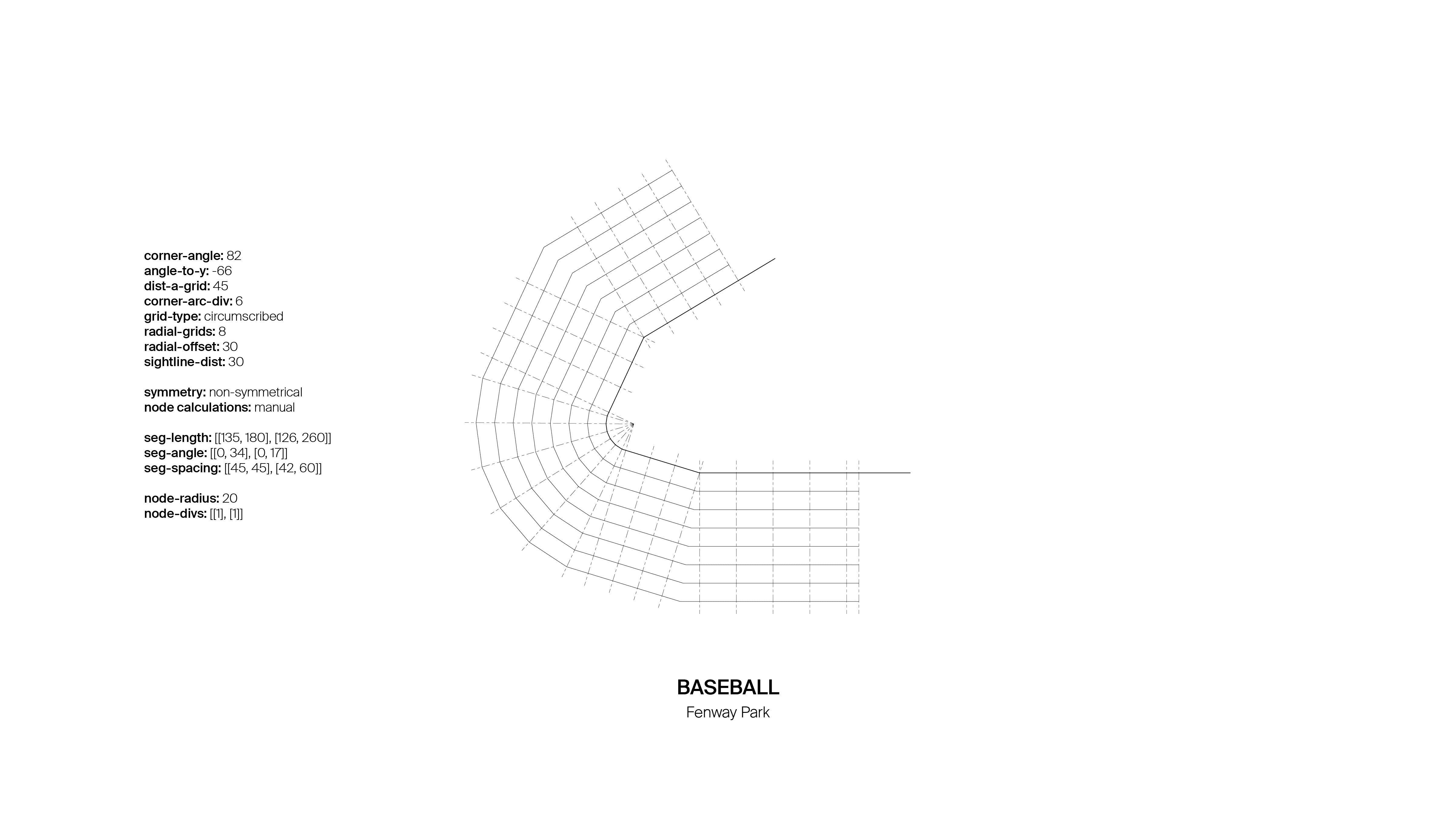


The process diagrams above illustrate the recreation of the iconic Fenway Park, a ballpark notorious for its “Green Monster” outfield wall and its irregular seating bowl. Using the computational tool, the seating bowl grids for Fenway were recreated in less than 10 minutes, exemplifying the tool’s efficiency and flexibility.

A seating bowl generated using the script's custom design grids, with irregular geometries, convex nodes, and complete control. The tool was fully integrated into Populous's existing C.A.R.V.E.R. bowl design tool.
POSTSCRIPT
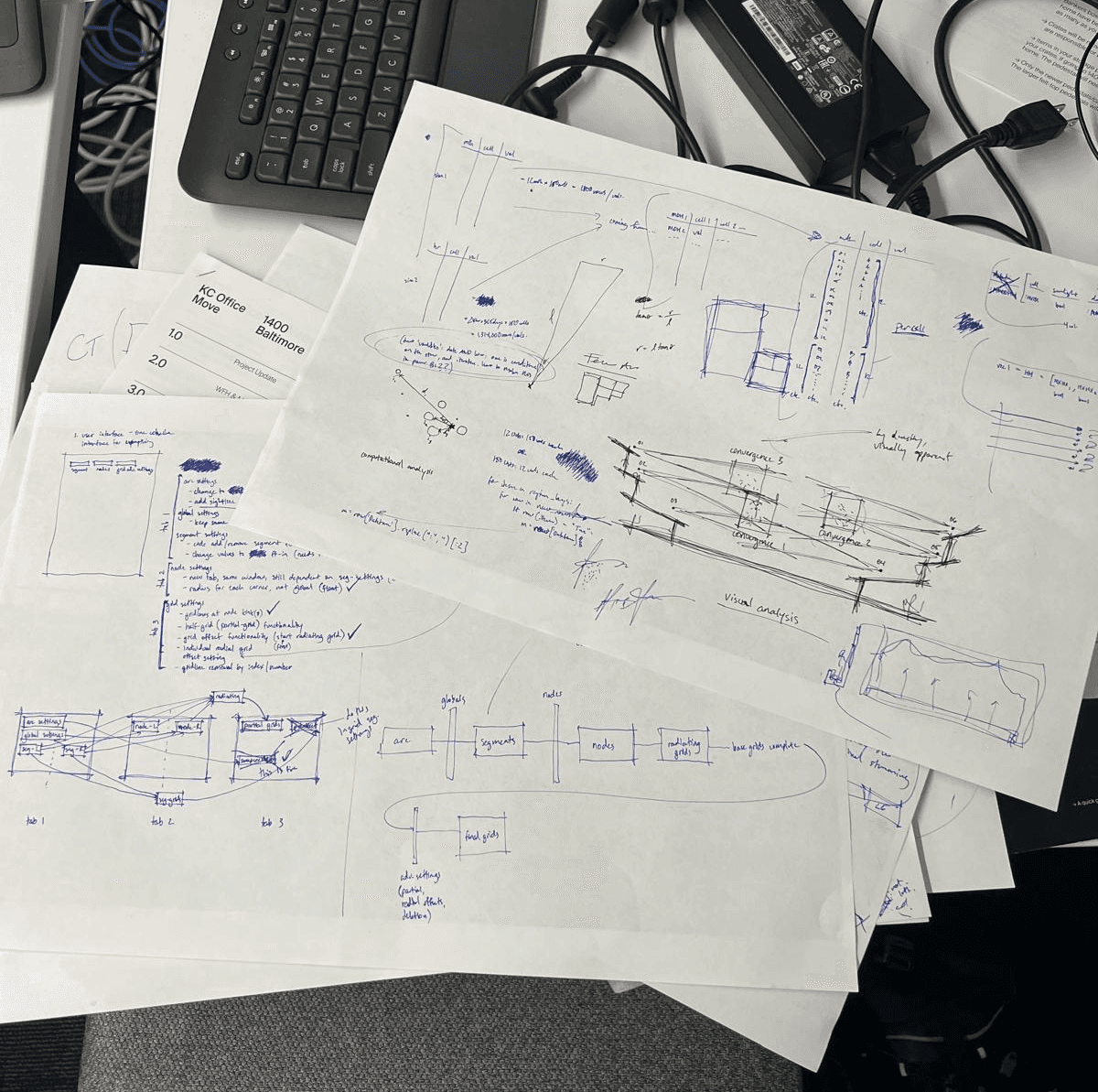
This project was completed in about two weeks, start to finish. After prototyping and then developing the plugin, it was sent to the Digital Team for final integrations and a more comprehensive user interface development. Below is an image of the thought process (sketches, sketches, sketches!!!):