Oculus
Integrating climate strategy into sports venue design
Computation
•
Plugin Development
ROLE
Computational Designer
TEAM
Individual Work

CONTEXT
Natural grass stadiums depend on a precise relationship between daylight, geography, building orientation, and roof geometry.
As stadiums become more complex, daylighting analysis becomes essential to determining whether a non-retractable grass field can perform without compromising the spatial and experiential goals of the venue.
GOALS
Evaluate potential stadium sites around the world based on daylighting conditions, solar exposure, and geographic performance;
Optimize stadium orientation, roof form, and oculus geometry to maximize daylight access and improve grass growth capability;
Analyze existing stadiums and projects in schematic or design development phases to identify strategies for enhancing field performance.
OUTCOMES
Built a computational tool for creating daylighting matrices on stadium fields.
Designed an optimization algorithm for roof oculus parameters to maximize natural light.
Created automations for analysis and graphic export.
ALGORITHM
The algorithm collects data at specified intervals, for a specified date range, and writes an Excel and .csv file containing the data below. The playing field is split into [x, y] [rows, columns] and each cell is given a code corresponding to its location in the grid.

The user has the option of inputting an existing stadium geometry, which prompts the algorithm to calculate daylighting on the field of play for every specified timeframe.
This is useful for projects anywhere from concept design to late schematic design/early design development as it can inform the design, placement, and material of elements such as roof panels or systems.
FUNCTIONALITY
If the user inputs an existing stadium geometry, they have the ability to parse through the data to produce heatmap visualizations in both Rhino and Adobe Illustrator. The algorithm writes the entire Illustrator file automatically.


Selected hours, daily cumulative
Monthly cumulative
The algorithm also has the ability to produce an ‘optimal oculus’ given a location and field of play region. This helps designers determine the degree to which this profile skewed from the field-of-play centerpoint.

To calculate a true optimized roof oculus, Galapagos, an evolutionary optimization algorithm, was utilized. Genome (parameter) inputs are as follows:
playing field angle to north;
oculus angle to north;
oculus x/2;
oculus y/2;
oculus corner radius;
oculus centroid height;
oculus slope angle.
Fitness is calculated with a user-defined weighted sum of percentage capture of total desired daylighting vs. roof surface area.
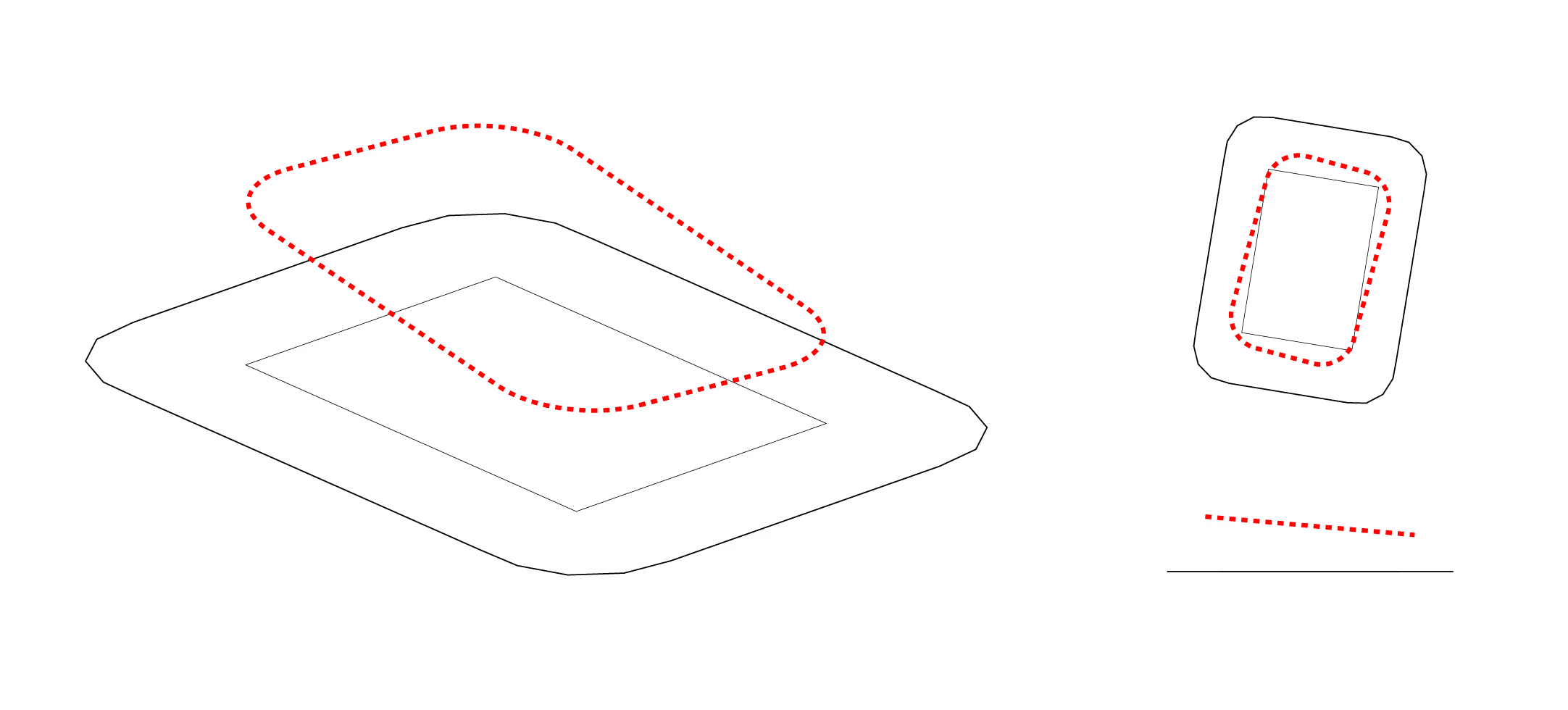


Test 1 Genome Outputs
2:1 weight - Daylight : Roof Area
Fitness Value: 1.838
Playing Field Angle to North: -9.3°
Oculus Angle to North: -15°
Oculus X/2: 139 ft
Oculus Y/2: 220 ft
Oculus Corner Radius: 74 ft
Oculus Centroid Height: 101 ft
Oculus Slope Angle: 5°
Test 2 Genome Outputs
2:1 weight - Daylight : Roof Area
Fitness Value: 1.799
Playing Field Angle to North: -0.5°
Oculus Angle to North: 11°
Oculus X/2: 145 ft
Oculus Y/2: 240 ft
Oculus Corner Radius: 10 ft
Oculus Centroid Height: 81 ft
Oculus Slope Angle: 9°
Since the simulation is a multi-objective optimization algorithm with several genomes, the produced fitness landscape likely has several valid solutions. Therefore, running multiple tests of the simulation is beneficial to attempt to obtain all plausible solutions in the fitness landscape.
POSTSCRIPT
This was the first computational software/plugin tool development project I had ever done. I learned a lot about data management, interfacing with the product's users (sustainability consultants, designers, and architects), and creating design systems that would align with their typical workflows.

I also learned the importance of sketching data structures and algorithmic concepts, the same way a designer would sketch conceptual design ideas or parti diagrams.

" height="19px" id="ypBAU5_zx" stroke-dasharray="0" stroke-linecap="butt" stroke-linejoin="miter" stroke-miterlimit="4" stroke-width="1.5" stroke="rgb(0, 0, 0)" transform="translate(2 2)" width="37px"/></svg>)